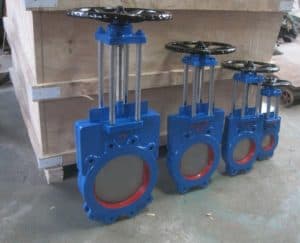
NTGD Slurry Knife Gate Valve for Abrasive Slurry and High-Solids Service
Slurry Knife Gate Valve
| Item | Standard Range |
|---|---|
| Pressure rating | PN10 / PN16 |
| Size range | DN50 to DN1000 |
| Connection type | Wafer, lug |
| Body material | Ductile iron, cast steel |
| Gate material | Stainless steel, alloy options available |
| Temperature range | -15°C to +200°C |
| Actuation | Manual, pneumatic, electric, hydraulic |
| Typical media | Slurry, sludge, tailings, ash slurry, pulp stock, chemical slurry |
NTGD Slurry Knife Gate Valve
Last updated: March 17, 2026 | Technical review by NTGD Valve Engineering Team
If your knife gate valves fail in months—or even weeks—due to abrasive slurry, tailings, or sludge, it is usually not a maintenance problem. It is a valve selection problem. Standard knife gate valves are not designed for high-solid, abrasive media. A slurry knife gate valve is.
NTGD slurry knife gate valves are engineered for abrasive slurry, mine tailings, sludge, ash slurry, and other solid-laden media where wear, buildup, gate blockage, and unstable shut-off are common failure modes. This page explains what a slurry knife gate valve is, when it should be selected instead of a standard valve, how it works, which design features actually matter in severe service, and how to choose the right configuration for mining, wastewater, power, and chemical applications.
This guide explains:
-
what a slurry knife gate valve is, and when you need it instead of a standard knife gate valve
-
why standard knife gate valves fail in abrasive slurry service, and how to avoid the same failure pattern
-
slurry knife gate valve working principle and the design features that actually control wear, clogging, and shut-off reliability
-
how to select body, gate, sleeve, and actuation options for mining, wastewater, sludge, and chemical slurry service
-
how to reduce seat wear, clogging, scaling, and short service life in slurry valve duty
-
how NTGD supports project review, datasheets, drawings, and custom quotation before RFQ
Request Technical Support
Get material guidance, typical configuration logic, and application notes for mining, wastewater, sludge, and abrasive slurry service.
Design Standards & Compliance
NTGD slurry knife gate valves are designed and tested with reference to recognized valve testing and slurry-service engineering requirements, including:
-
MSS SP-81 — knife gate valve design basis
-
API 598 — valve inspection and testing
-
ISO 5208 — pressure testing framework
-
Customer-specific slurry erosion velocity review for severe-service applications
All valves undergo 100% pressure shell and seat testing before shipment. For project orders, NTGD can also support material review, dimensional confirmation, and application-based configuration checks before quotation.
Where applicable, compliance documents, inspection records, and supporting technical files are available through the NTGD technical team or project documentation package.
What Is a Slurry Knife Gate Valve?

A slurry knife gate valve is a heavy-duty isolation valve designed for media that contains solids, abrasive particles, settled slurry, or thick sludge. Unlike a standard knife gate valve used mainly for lighter shut-off duties, a slurry knife gate valve is built around the failure mechanisms that appear in severe service: abrasion, solids accumulation, clogging, unstable gate travel, and loss of shut-off integrity.
Typical applications include:
-
mine tailings
-
ore slurry
-
fly ash slurry
-
sludge
-
pulp stock
-
wastewater solids
-
corrosive chemical slurry
The key difference is not simply that the valve is “stronger.” The real difference is that a slurry knife gate valve is designed to survive conditions that damage standard shut-off valves quickly. In slurry service, the engineering problem is not only opening and closing the line. It is maintaining shut-off performance while abrasive solids continuously attack the sealing and flow path geometry.
Industry Terminology Note
In the field, operators and buyers often use different terms for similar service requirements. Terms such as heavy duty knife gate valve, sludge valve, slurry gate valve, or gate valve for slurry are often used to describe a slurry-duty knife gate valve, even if they are not identical product categories.
The term sacrificial valve is not a formal valve type, but it sometimes appears in severe abrasive-service discussions. It usually refers to a low-cost valve that is expected to wear out and be replaced frequently. In contrast, NTGD slurry knife gate valves use replaceable wear-related components, such as sleeve-based sealing systems, to reduce the need for full valve replacement.
Similarly, a buyer searching for an auto gate valve is often looking for an automated shut-off solution. In slurry pipelines, that usually means a pneumatic slurry knife gate valve, electric slurry knife gate valve, or hydraulic knife gate valve with enough operating thrust to move through dense or solids-laden media.
For wastewater and sludge handling, the term sludge valve often refers to the same functional requirement: a valve that can isolate thick, high-solid media without clogging and without losing shut-off stability after repeated cycles.
When Should You Use a Slurry Knife Gate Valve?
A slurry knife gate valve should be selected when the service is no longer suitable for a standard knife gate valve. In most plants, that decision becomes clear when wear, clogging, or unstable shut-off starts appearing in actual operation.
Typical selection triggers
A slurry knife gate valve should be considered when:
-
solids content is high
-
particles are abrasive or sharp
-
sedimentation or solids packing is likely
-
standard knife gate valves wear out rapidly
-
shut-off becomes unreliable due to buildup
-
maintenance intervals are too short
-
the valve must cycle through thick or settled media
-
leakage increases after repeated operation
Typical warning signs in the field
If a valve is already in service, the following symptoms usually indicate that slurry-duty geometry and materials are required:
-
seat wear within weeks or a few months
-
solids trapped near the shut-off path
-
incomplete closure caused by buildup
-
rising operating load during open/close cycles
-
coating failure followed by rapid wear or scale adhesion
-
frequent cleaning, flushing, or disassembly just to restore function
This is why the decision should not be reduced to pressure class and nominal size alone. Many line failures happen because the service demands a slurry-duty shut-off valve, but the installed valve was selected as if it were a light-duty isolation valve.
Why Standard Knife Gate Valves Fail in Slurry Service
Many slurry valve failures are not caused by manufacturing defects. They are caused by selecting a valve that was never designed for the way slurry behaves in service.
1. Seat wear occurs too fast
Abrasive particles continuously attack the shut-off surfaces. In clean water service, this may not matter much. In tailings or ash slurry, it can destroy sealing performance very quickly.
2. Solids accumulate near the gate path
Settled material and sticky solids can pack into the shut-off path, especially when the valve body geometry traps media rather than clearing it. Once accumulation begins, gate travel becomes unstable and shut-off reliability falls.
3. Gate movement becomes difficult under solids load
Dense slurry, coarse particles, or settled deposits can raise the operating load dramatically. A valve that works well in lighter media may struggle to close through dense, solids-bearing flow.
4. Coatings alone rarely solve severe slurry problems
Some users try to prevent wear or scaling only by upgrading coating systems. Coatings can help in moderate service, but in severe slurry duty they are rarely sufficient by themselves. Once coating damage occurs, exposed surfaces face rapid abrasion and buildup.
5. Maintenance economics become unacceptable
A valve may appear less expensive at purchase, but repeated replacement, shutdowns, leakage, and cleaning usually make it much more expensive over time in slurry service.
How the Design Counters These Failure Modes
A correctly configured slurry knife gate valve addresses those same failure modes directly:
-
Combating abrasion: a sleeve-based sealing system helps protect structural surfaces from direct abrasive attack
-
Combating clogging: push-through or open-bottom geometry reduces solids trapping near the shut-off path
-
Combating unstable shut-off: compressible sealing interfaces can maintain better shut-off behavior in media that contains minor residual solids
-
Combating gate blockage: stronger guidance and correct actuation improve gate travel through thick or settled media
This is why standard knife gate valves and slurry knife gate valves should not be treated as interchangeable options with different price levels. They solve different problems.
Slurry Knife Gate Valve vs Standard Knife Gate Valve

The most important difference is not the name. It is the service boundary.
| Comparison Point | Standard Knife Gate Valve | Slurry Knife Gate Valve |
|---|---|---|
| Typical service | Clean or light-duty media | Abrasive slurry, tailings, sludge, solids-laden media |
| Solids tolerance | Limited | High |
| Wear resistance | Moderate | High |
| Sealing design | Basic shut-off design | Designed for abrasive and solids service |
| Clogging risk | Higher in settled solids | Lower with slurry-duty geometry |
| Maintenance interval | Shorter in slurry service | Longer in slurry service |
| Best use case | General isolation | Slurry isolation and heavy-duty process duty |
Performance Benchmarking Note
The qualitative differences above translate into measurable maintenance and uptime outcomes in the field. In highly abrasive tailings applications, a standard valve may lose shut-off performance within weeks. A properly specified slurry knife gate valve, especially one using a replaceable sleeve-based sealing system and slurry-duty body geometry, can extend service intervals to many months or longer, depending on media severity and cycling conditions.
The real decision is not “basic valve vs premium valve.”
It is often:
-
frequent replacement and unstable shutdowns
-
versus a design that is maintainable, serviceable, and economically sustainable in abrasive duty
How a Slurry Knife Gate Valve Works

A slurry knife gate valve isolates flow by moving a gate blade through the flow path. In slurry service, that movement must do more than simply stop the line. It must pass through solids, limit accumulation near the shut-off zone, and preserve sealing reliability under abrasive conditions.
Basic operating sequence
-
Valve open
The gate is fully withdrawn and the flow path is open for slurry passage. -
Closing movement
The gate travels through the media and cuts through solids while moving toward the shut-off position. -
Shut-off position
The gate reaches the sealing path. In slurry-duty designs, the sealing arrangement is configured to reduce solids trapping and support more stable shut-off. -
Reopening movement
The gate rises again through slurry conditions that may include settled solids, residual buildup, or sticky deposits.
Why this matters in slurry service
In clean service, opening and closing are relatively simple. In slurry service, the valve must handle:
-
repeated abrasive impact
-
solids that settle during slow flow or idle time
-
thick sludge that resists gate movement
-
particles that damage conventional sealing interfaces
That is why shut-off reliability in slurry service depends heavily on body geometry, sleeve design, gate guidance, and operating thrust.
How the operating design solves actual field problems
-
A replaceable sleeve absorbs wear that would otherwise attack the body or shut-off path
-
A push-through or open-bottom path helps move solids out of the body instead of trapping them
-
A slurry-duty gate path improves the valve’s ability to close and reopen without packing debris into the sealing area
Design Features That Matter in Slurry Service
Not every advertised “heavy-duty” feature provides real value in slurry service. The following features directly affect shut-off stability, wear rate, and maintenance interval.

Push-through / open-bottom design
One of the most important slurry-service design features is the ability to reduce solids accumulation during gate movement. A push-through or open-bottom design helps the valve clear thick media and settled solids rather than trapping them in the body.
This improves:
-
anti-clogging performance
-
gate travel reliability
-
shut-off stability
-
service interval
Replaceable sleeve or elastomer-based sealing system
A replaceable sleeve is one of the most practical design features in severe slurry duty, especially in applications where abrasive valve service drives maintenance cost and shut-off instability. Instead of exposing key surfaces directly to the media, the sleeve helps protect the internal flow path and provides a maintainable sealing interface.
Engineering benefits include:
-
better isolation from abrasive attack
-
improved shut-off behavior in slurry
-
reduced body wear
-
easier restoration of service performance through sleeve replacement
This is also why search terms such as elastomeric sleeved knife gate valve often appear in slurry-service RFQs.
Heavy-duty gate and frame construction
In dense slurry, the gate must remain aligned under load. Weak gate guidance can lead to uneven wear, blocked travel, or unstable shut-off. A slurry-duty valve typically requires stronger gate support, more robust guidance, and higher available thrust.
Material selection matched to actual media
The correct slurry valve is not selected by size and pressure alone. It must also be selected around:
-
particle hardness
-
solids concentration
-
particle size and shape
-
corrosiveness
-
temperature
-
cycling frequency
-
scale or buildup tendency
How to Select the Right Slurry Knife Gate Valve
A slurry knife gate valve should be selected around the actual service conditions, not only around nominal pipeline size or flange pattern, which is also the core principle in selecting the right knife gate valve for slurry and high-solids media.
Selection flowchart for choosing the right slurry knife gate valve based on media characteristics and operating conditions.
1. Select by media characteristics
Start with the media itself:
-
What is the solids content?
-
What is the maximum particle size?
-
Are the particles angular, sharp-edged, or rounded?
-
How abrasive are the particles?
-
Is the media corrosive?
-
Does it scale, cake, or settle easily?
Why particle size and shape matter
A valve that handles fine slurry may fail rapidly if the same service later includes large, sharp-edged ore fragments. Maximum particle size affects required flow-path clearance and gate design. Particle shape affects wear rate on both the gate and sleeve, a point widely recognized in slurry erosion engineering research. Angular particles usually create a much more aggressive wear environment than rounded particles.
2. Select by operating conditions
Then review:
-
operating pressure
-
temperature
-
flow velocity
-
cycling frequency
-
manual or automated duty
-
installation constraints
Some users search for high temperature knife gate valve or high pressure knife gate valve because the service is already beyond standard slurry duty. In those cases, configuration review becomes more important than catalog selection.
3. Select by body, gate, and sleeve materials
Material selection should follow the service:
-
Body material for structural strength and corrosion environment
-
Gate material for abrasion resistance and shut-off duty
-
Sleeve or sealing material for wear, chemistry, and temperature compatibility
4. Select by actuation type
Actuation should not be treated as an afterthought.
-
Manual actuation Knife gate valve suits smaller valves and lower operating load
-
Pneumatic actuation Knife gate valve is common where automation and repeatable force are required
-
Electric actuation Knife gate valve is useful where air supply is limited and cycling is moderate
-
Hydraulic actuation Knife gate valve is often selected for larger valves or high-thrust applications
Application-Based Recommendation Table
The table below provides a practical starting point. Final material and design selection should always be reviewed against actual process conditions.
| Application | Typical Media | Main Challenge | Typical Recommendation | Recommended Gate Material | Recommended Sleeve Material |
|---|---|---|---|---|---|
| Gold or copper tailings | Abrasive mineral slurry | Severe wear, solids settlement | Heavy-duty slurry knife gate valve with abrasion-resistant sleeve and reinforced actuation | Duplex Stainless Steel 2205 | Polyurethane (PU) |
| Sludge dewatering | Thick sludge, high solids | Clogging, sticky media | Open-bottom slurry knife gate valve with sleeve sealing | 316 Stainless Steel | EPDM |
| Fly ash slurry | Abrasive ash slurry | Wear, high cycle duty | Slurry-duty valve with upgraded gate material and suitable sleeve option | Hard Chrome-Plated Carbon Steel | NBR |
| Pulp and paper | Pulp stock, fibrous slurry | Fiber buildup, shut-off instability | Slurry-duty design with solids-clearing gate path | 304 Stainless Steel | EPDM |
| Chemical slurry | Corrosive solids-bearing media | Corrosion + abrasion | Material review required for body, gate, and sleeve compatibility | Hastelloy C276 / Alloy 20 | FKM / Viton |
| Wastewater solids | Sludge, grit, solids-bearing water | Sealing instability, sedimentation | Slurry-service knife gate valve with robust shut-off design | Coated stainless gate | EPDM |
| High temperature / high pressure slurry | Hot abrasive slurry, high operating pressure | Thermal stability, wear resistance | Custom heavy-duty slurry knife gate valve with reviewed materials and sealing system | Alloy steel / stellite-upgraded gate | Graphite-reinforced PTFE or service-specific option |
For custom high-temperature, high-pressure, or corrosive slurry applications, contact NTGD engineers for a free material compatibility review and valve recommendation, especially when reviewing knife gate valve materials and linings for abrasive or chemical service.
Material and Configuration Selection Guide
The table below helps move from general interest to practical configuration thinking.
| Service Type | Media Characteristic | Design Priority | Material Focus | Engineering Goal |
|---|---|---|---|---|
| Abrasive tailings | High wear, high solids | Push-through solids-clearing path | Wear-resistant gate and sleeve pairing | Extend service interval |
| Sludge handling | Sticky, settling media | Anti-clogging body geometry | Sleeve and shut-off compatibility | Prevent blockage and unstable closure |
| Corrosive slurry | Chemical attack + solids | Material compatibility review | Corrosion-resistant metal + suitable seal system | Control corrosion and shut-off loss |
| High-cycle duty | Frequent opening/closing | Stable guidance and operating load review | Gate support and seal durability | Improve repeatability and uptime |
| Elevated temperature service | Hot slurry with solids | Thermal and sealing review | Temperature-compatible metals and sealing materials | Maintain structural and sealing stability |
The correct question is not only “What size valve do I need?”
The better question is:
-
what is wearing the valve?
-
what is blocking the gate path?
-
what is causing leakage?
-
which component should be serviceable instead of sacrificing the whole valve body?

Performance in Abrasive and Solids-Laden Service

Wear resistance
A slurry-duty valve is selected because abrasive particles attack conventional shut-off systems quickly. The goal is not just to use a harder metal. It is to manage where wear occurs and to keep critical structural areas out of the most aggressive wear path when possible.
Sealing reliability
Reliable shut-off in slurry service depends on both sealing design and solids behavior. If solids are trapped repeatedly near the shut-off path, even a strong seat material may not provide stable long-term performance.
Reduced maintenance burden
A proper slurry knife gate valve should reduce:
-
unplanned shutdowns
-
frequent cleaning
-
short replacement cycles
-
labor spent restoring shut-off after buildup or wear
Maintenance logic
In severe slurry duty, maintainability matters. Designs that allow service components to be replaced can reduce lifecycle cost compared with replacing the full valve body after shut-off degradation.
Real-World Service Evidence
The purpose of these examples is not to claim that one valve fits every slurry line. It is to show how slurry-service design changes maintenance reality when the valve is matched correctly to the media and operating conditions.
Case 1: Gold Mining Tailings Pipeline
Application: DN450 gold mining tailings pipeline, Africa
Media conditions: Ore slurry with high silica content, approximately 35% solids, abrasive mineral particles, PN10 pressure, ambient temperature
Original problem: A standard knife gate valve suffered severe seat wear and gate binding within about 3 weeks. The plant experienced repeated maintenance interruptions and leakage-related shutdown risk.
NTGD configuration: Heavy-duty slurry knife gate valve with push-through open-bottom body, abrasion-focused gate specification, replaceable polyurethane sleeve sealing system, pneumatic actuation with reinforced operating force
Quantified result: Maintenance frequency dropped from roughly weekly intervention to zero unplanned maintenance for 8 months, and the operating cost related to repeated valve replacement and shutdowns was reduced by approximately 68% over the review period.
Note: After extended service, only the replaceable sleeve showed wear progression, allowing restoration without replacing the full valve body.
Case 2: Sludge Dewatering Line
Application: Sludge transfer and dewatering system
Media conditions: Thick sludge with high solids content and strong settling tendency
Original problem: Solids packing caused repeated blockage near the shut-off path. Clogging-related interruptions occurred around 3 times per month, and effective valve life was only about 3 months before shut-off performance degraded.
NTGD configuration: Slurry-duty knife gate valve with solids-clearing open-bottom path, sleeve-based shut-off system, and application-matched materials for sludge duty
Quantified result: Clogging-related stoppages were reduced from 3 per month to 0, and valve life extended from roughly 3 months to 24 months under comparable operating conditions.
Case 3: Abrasive Ash Slurry Service
Application: Fly ash or abrasive slurry transfer duty
Media conditions: Abrasive solids-bearing slurry with frequent cycling
Original problem: The previous valve showed rapid wear at the sealing interface. Seal-related wear intervals were around 6 weeks, creating repeated maintenance cost and unstable shut-off.
NTGD configuration: Slurry-service knife gate valve with reviewed gate material, suitable sealing configuration, and improved operating load matching
Quantified result: Seal-wear interval increased from about 6 weeks to 18 months, and maintenance cost associated with repeated replacement fell by approximately 72%.
Actual results may vary depending on media severity, operating cycle, pressure, and maintenance conditions. Submit your application details for a custom performance projection
Need a Similar Case Review?
See how NTGD slurry valves perform in applications similar to yours, tap Contact us!
NTGD Engineering and Manufacturing Support
NTGD supports project-based slurry valve supply as a direct manufacturer for abrasive and solids-laden applications. For many buyers, the most valuable support happens before the quotation stage, when the application still needs engineering review.
NTGD can assist with:
-
valve type confirmation for slurry service
-
size and pressure review
-
gate and sleeve material recommendation
-
automation and actuation review
-
drawing and specification confirmation
-
application review for mining, wastewater, sludge, fly ash, and chemical slurry systems
-
international project support and shipment coordination where required
This matters because many slurry-service failures are caused by mismatch between the media and the valve configuration, not by size error alone.
Why Buyers Choose Slurry Knife Gate Valves for Mining, Wastewater, and Process Slurry

For industrial buyers, the selection decision is rarely based on one advertised feature. It is based on whether the valve can maintain shut-off and manageable maintenance under real operating conditions.
Typical reasons for selection include:
-
better suitability for abrasive solids
-
lower clogging risk than standard shut-off designs
-
stronger shut-off reliability in sludge and tailings service
-
longer service interval in difficult media
-
customization options for pressure, size, actuation, and materials
A slurry knife gate valve is not the answer to every valve application. But when the line contains abrasive or solids-laden media, it is often the valve type that best matches the actual engineering problem.
Request a Free Slurry Valve Application Review or Custom Quote
NTGD’s engineering team supports abrasive slurry, tailings, sludge, and high-solid media projects with pre-quotation technical review.
To get a fast recommendation, you only need to provide:
-
line size and operating pressure
-
media type and solids content
-
your main challenge: wear, clogging, leakage, or short service life
NTGD can then review the application and provide a valve recommendation, technical guidance, and quotation support.
Response target: within 24 business hours for standard inquiries
Project support available for mining, wastewater, sludge, ash slurry, and process slurry applications
FAQ
What is the difference between a slurry knife gate valve and a standard knife gate valve?
A standard knife gate valve is typically used for lighter shut-off service, while a slurry knife gate valve is designed specifically for abrasive, solids-laden, or settling media. The main difference is service survivability. A slurry-duty valve is engineered to reduce wear, resist clogging, and maintain shut-off performance under severe conditions.
Why do knife gate valves fail in slurry service?
They usually fail because slurry service introduces abrasive wear, solids accumulation, scale buildup, and blocked gate travel. Standard valves are often not designed to manage those combined failure modes over time.
What is a heavy duty knife gate valve?
In practical industry usage, a heavy duty knife gate valve generally refers to a valve built for more demanding service than a standard knife gate valve. In abrasive slurry applications, that often means a slurry-duty knife gate valve with reinforced construction, solids-clearing geometry, and a more suitable sealing arrangement.
How do you prevent clogging in slurry valve service?
Clogging is reduced by correct valve selection, proper body geometry, solids-clearing gate movement, and a sealing system suited to settled or abrasive media. In many cases, a push-through or open-bottom slurry-duty design performs better than a basic shut-off valve in solids service.
How do you prevent scaling or buildup on gate valves in slurry pipelines?
Coating alone is rarely enough in severe slurry service. Scale and buildup are better controlled through a combination of smooth flow path design, reduced solids-trapping geometry, suitable material selection, and a sealing arrangement that does not trap deposits easily. NTGD’s slurry-duty design is intended to reduce buildup risk in high-solid media.
How do you reduce wear in a slurry knife gate valve?
Wear reduction depends on matching the valve design and materials to the media. Important variables include particle hardness, solids concentration, particle size, gate material, sleeve design, and cycle frequency. A replaceable sleeve-based sealing system can also improve maintenance economics.
What is an elastomeric sleeved knife gate valve?
It refers to a knife gate valve that uses an elastomer sleeve as part of its sealing and media-protection system. In slurry service, this design can help isolate the body from abrasion and improve shut-off performance.
Are slurry knife gate valves suitable for sludge service?
Yes. They are commonly used in sludge handling, sludge dewatering, wastewater solids, and similar applications where buildup, high solids, and shut-off reliability are major concerns.
Who is a reliable slurry knife gate valve manufacturer or distributor for abrasive service?
A reliable supplier should be able to provide more than catalog data. Buyers should look for engineering review before quote, slurry-service configuration support, technical documentation, and experience with abrasive or solids-laden applications. NTGD provides slurry knife gate valve solutions as a direct manufacturer, with engineering review, project documentation support, and international supply capability.
What support does NTGD provide as a direct manufacturer for international projects?
NTGD can support material review, valve configuration, dimensional confirmation, technical file preparation, and shipment coordination for international projects. This helps reduce RFQ errors and improves application matching before order placement.
What is the standard pressure rating for slurry knife gate valves?
The standard NTGD slurry knife gate valve range typically covers PN10 and PN16, with custom review available for applications requiring higher pressure capability. Pressure selection should always consider real operating pressure, test pressure, and the severity of abrasive slurry conditions.
What is the typical lifespan of a slurry knife gate valve in abrasive service?
Service life depends on media abrasiveness, solids concentration, cycling frequency, and configuration. In severe slurry applications, a properly configured NTGD slurry knife gate valve may achieve many months or much longer service life, while a standard knife gate valve in the same duty may fail within weeks. For a more accurate estimate, submit your application details for review.
Is there a high temperature knife gate valve for slurry applications?
Yes. Standard NTGD slurry knife gate valves cover temperatures up to about 200°C, but higher-temperature slurry duty requires a different material and sealing review. For elevated temperatures, sleeve materials and shut-off configuration must be selected specifically for the service. Contact NTGD for a high-temperature application review.
What is considered a high pressure knife gate valve for slurry service?
For many slurry knife gate valve applications, standard duty is in the PN10 to PN16 range. Applications above that range are often treated as higher-pressure knife gate valve service and may require a different body design, reviewed wall section, and higher thrust actuation. NTGD can evaluate feasibility based on your operating and test pressure requirements.
Can a slurry knife gate valve be pneumatic or electric?
Yes. Depending on valve size, cycle duty, and required force, slurry knife gate valves can be manual, pneumatic, electric, or hydraulic. Automated service should always include operating-load review to ensure sufficient thrust.
What size range is available?
NTGD slurry knife gate valves are commonly available from DN50 to DN1000. Final availability depends on pressure rating, material configuration, and application requirements.